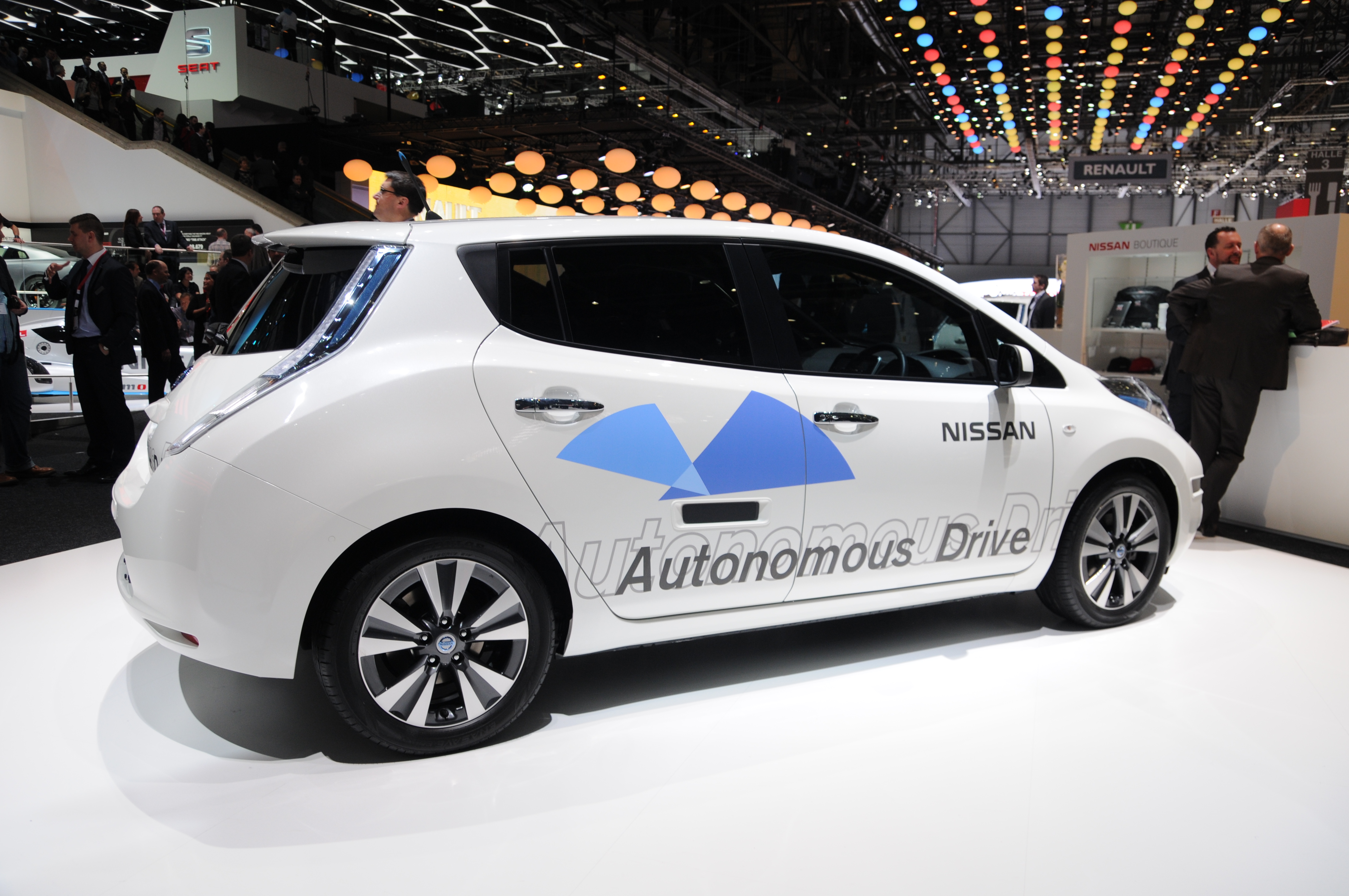
Until now, I haven't paid much attention to Uber's business model, but this article made me think about it, and the entire company's future seems to be built on two very big ifs. I have trouble seeing both of these ifs breaking their way.
Uber isn't making any money with its current business plan. In fact, it is losing money at an alarming rate. It lost $1.27 billion in the first half of this year. The company is not charging nearly enough to be able to cover the cost of their human drivers, the biggest expense at the moment. What Uber is doing now is completely unsustainable, but their plan is to burn through a huge amount of money to grow quickly and make money later.
The problem is that the main way Uber plans to make money later, apparently, is by replacing its drivers with much cheaper self-driving cars. For this to work, though, two big things need to go Uber's way.
1) True self-driving cars need to be developed fast enough that regulators will let them travel without human supervision before Uber runs out of cash. So far the technology is looking promising, but there are reasons to be skeptical.
2) The bigger bet is that once this self-driving technology is developed, people will keep using Uber. While people currently associate Uber with getting a ride, people also associate cars/travel with a lot of companies. When people think of cars, they think of the big car companies. When people think of finding directions, they think of Google and Apple maps. When people think of finding places to go, they think of companies like Yelp and Aroundme. There is no reason to think Ford, Tesla, Google, Apple, or even Yelp can't launch their own equally successful ride app once the self-driving cars are ready to make autotaxi services profitable.
Uber is probably getting some great data about millions of people's travel patterns, but that
data isn't unique. Obviously map programs
like Google maps, as well as apps that are almost always on like Facebook, probably have a decent or even better body of travel data to draw from.
It seems Uber's plan is to lose billions mainly so at some point in the future people will automatically think of them as "the ride app." My question is: do you think all this will beat Google, Apple, or Samsung just deciding to include their own default ride app on their new phones? It is possible, but it's a big if.
In poker terms, Uber seems to be betting billions on the flop hoping they can pick up two spades on the turn and the river to make their flush. That is normally considered a fool's bet. The fact that there is so much money in Silicon Valley willing to get behind such bets should raise wider questions.
Friday, August 26, 2016
Monday, August 22, 2016
How self-driving cars could indirectly help San Francisco's housing crisis
San Francisco has a housing affordability crisis which could be solved by building a lot more large apartment buildings, but the political dynamics prevent that from happening. Currently the laws and political dynamics prevent most development that changes the size of buildings, their historic appearance or building heights in the city. There is, though, a large quantity of already existing ground-level space in the city that could be used for housing: the city's abundant street-level garages.

San Francisco is full of ugly street-level garages - numerous streets dominated by big, blank, boring garage doors. Many of these could be turned into attractive new street-level apartments without significantly changing the height, character or general appearance of the neighborhood.
At the moment this isn't really an option because even in a highly walkable city, people want their cars. Current residents in these buildings don't want to give up their garages for conversion, and even if they did, they likely wouldn't legally be allowed to, thanks to opposition from neighbors who wouldn't want to make it harder to find "free" street parking.
The development of very cheap, always available self-driving taxi services will likely change this dynamic, at least in dense cities. These services will make personal car ownership --which comes with the need to find a place to park your car the 90% of the time it is not in use-- far less appealing. The fewer people who own cars, the fewer who will want to waste very valuable space for storing cars.
San Francisco has 379,597 housing units. Even if just 10% of all housing units (37,900) have existing ground-level garages that could be converted into apartments, that would still be a significant increase in the housing supply. By comparison, in 2014 the city had a net increase of only 3,514 units.

San Francisco is full of ugly street-level garages - numerous streets dominated by big, blank, boring garage doors. Many of these could be turned into attractive new street-level apartments without significantly changing the height, character or general appearance of the neighborhood.
At the moment this isn't really an option because even in a highly walkable city, people want their cars. Current residents in these buildings don't want to give up their garages for conversion, and even if they did, they likely wouldn't legally be allowed to, thanks to opposition from neighbors who wouldn't want to make it harder to find "free" street parking.
The development of very cheap, always available self-driving taxi services will likely change this dynamic, at least in dense cities. These services will make personal car ownership --which comes with the need to find a place to park your car the 90% of the time it is not in use-- far less appealing. The fewer people who own cars, the fewer who will want to waste very valuable space for storing cars.
San Francisco has 379,597 housing units. Even if just 10% of all housing units (37,900) have existing ground-level garages that could be converted into apartments, that would still be a significant increase in the housing supply. By comparison, in 2014 the city had a net increase of only 3,514 units.
Thursday, August 4, 2016
The arrival of self driving taxis can't be stopped
There is no stopping self-driving taxis -- soon they will be on the streets in Singapore. From the BBC:
The article makes it clear self-driving taxis should be dramatically cheaper than regular taxis. This alone will make them very appealing to regular people; but they will also likely be safer, more readily available, and cleaner.
This story highlights why any effort to stop self-driving vehicles from replacing millions of American jobs in the near future is likely to fail. Opponents to automating almost all of our vehicles need to win everywhere, but the companies behind self-driving vehicles need to win in just one jurisdiction. If they can prove the concept in just one place while delivering a truly superior product, it will be almost impossible to stop it from spreading.
The driverless cabs could reduce an average $3-a-mile ride to 90 cents, the firm said.
Initially, the cars will have drivers, ready to take over if the system fails but the plan is to gradually phase the human out in 2019.
The small fleet of six Audi vehicles will travel along a 3.5 mile (5.6km) route in One North, a business district in the city.
By 2019, the plan is to have fully autonomous cars without steering wheels but they will only be tested with a "controlled group of people," according to the firm.
The article makes it clear self-driving taxis should be dramatically cheaper than regular taxis. This alone will make them very appealing to regular people; but they will also likely be safer, more readily available, and cleaner.
This story highlights why any effort to stop self-driving vehicles from replacing millions of American jobs in the near future is likely to fail. Opponents to automating almost all of our vehicles need to win everywhere, but the companies behind self-driving vehicles need to win in just one jurisdiction. If they can prove the concept in just one place while delivering a truly superior product, it will be almost impossible to stop it from spreading.
Wednesday, July 20, 2016
An actually great idea from Donald Trump

There is a new idea from Donald Trump I think everyone across the political spectrum should get behind. He is planning to announce his potential cabinet picks at the convention. I honestly hope Trump does and this sets a precedent for all future presidential candidates.
The simple fact is that the main job of the president is to run the executive branch. That is where a presidency tends to have the biggest impact. However, deciding most of the nitty gritty details around new government rules, regulations, and enforcement is frequently delegated to the cabinet. The president simply has only so much time in a day.
A candidate's campaign promises and broad statements of principle on the stump may give you some idea of how they may set new regulations around coal emissions or spectrum rules, but knowing their cabinet picks can potentially be much more informative. If Trump were to select Chris Christie or Rand Paul as his attorney general, that would tell me way more about his administration's likely approach to marijuana policy than any of his vague answers so far.
I'm all for an informed electorate. The more information, the better. If candidates announced their likely cabinet picks before the election, it would be the biggest increase in useful information for the electorate in modern politics. It is maybe the one Trump idea I can honestly get behind and hope changes the future.
Monday, July 11, 2016
Portland's geographic destiny
Portland, Oregon’s geography makes it destined it to be a massive city, as long as the local politics will allow it. Geographically, it has the rare combination of great water access, great land, and great weather, which in similar locations has resulted in some of the largest cities on earth.
Water - Portland sits at the junction of the Columbia and Willamette rivers, two of the most significant rivers in the western half of North America. That gives the city plenty of fresh water for a huge population and natural access to sea transportation.
Land - There is both plenty of relatively flat land to build directly in the city (unlike San Francisco), and the city is very close to high quality farmland. The Willamette Valley is one of the best natural agricultural areas on Earth. It was once considered the new promised land of milk and honey.
Weather - Portland rarely ever gets dangerously hot or cold. The average January low is 36 degrees, and the average August high is 81. This means relatively little energy is needed to heat or cool buildings.
If North America had been flipped and Europeans had first landed on the West Coast, it is likely Portland would have ended up the biggest city in the country. The question shouldn't be why Portland is growing so fast right now, but why it took so long.
It is mainly because of Portland's very late founding date and 20th century technology that the city remained as small as it did. Mega engineering projects took away Portland's biggest advantage over other Western locations. Huge aqueducts brought water to the dry parts of California, like Los Angeles. The interstate highway system made it possible to ship food from all over the world. Air conditioning and a massive power grid made incredibly hot desert locations like Phoenix tolerable.
But the tide is turning. California is running low on water even as it imports it from hundreds of miles away. Global warming is making hot locations less pleasant even with AC, and more people are interested in eating local again.
Portland is starting to live up to its geographic destiny and will do so, as long as the local politicians let it. A look at California cities like Mountain View and Palo Alto serves as a reminder that no matter how many people want to move to a location, it is possible to stop growth via regulations which end up pushing housing prices to shocking levels.
Tuesday, May 17, 2016
The self-driving trucks are coming
I once predicted that the unique nature of trucks would make them the first place self-driving technology is fully embraced and it now seems that some of the biggest names in technology feel the same way. From the New York Times:
Hopefully our politicians will act in a timely manner to deal with the job displacement issue, because large shocks to employment combined with changing in a the nature of cities is recipe for the areas becoming new pockets of entrenched poverty.
My first sci-fi novel, Cobalt Slave, is now on sale at Amazon. Please consider leaving a review.
Despite Silicon Valley’s enthusiasm for self-driving cars, it could be years before there are many of them on the road. But autonomous 18-wheelers? One start-up is betting that is a different matter.
Otto, led by 15 former Google engineers, including major figures from the search company’s self-driving car and maps projects, is aiming at the long-haul freeway driving that is the bread and butter of the commercial trucking industry.
Once the technology behind self-driving vehicles is fully realized it is going to do two things. One it will cause massive employment displacement. Second it redefine the nature of cities due to changes in people's transportation needs.The engineers think that automating trucks rather than passenger vehicles could be more palatable financially and to regulators. Nationally, trucks drive 5.6 percent of all vehicle miles and are responsible for 9.5 percent of highway fatalities, according to Department of Transportation data.
Hopefully our politicians will act in a timely manner to deal with the job displacement issue, because large shocks to employment combined with changing in a the nature of cities is recipe for the areas becoming new pockets of entrenched poverty.
My first sci-fi novel, Cobalt Slave, is now on sale at Amazon. Please consider leaving a review.
Tuesday, April 12, 2016
The problem of AI ownership
The people currently getting an advanced education in China and India are, of course, autonomous individuals. But any true AI developed by a company would be owned under current IP law. In addition, any work product of the AI would be owned by the company.
Any smart company that makes a true AI would instruct it to design an even better AI, which would in turn be instructed to design a better AI, and so on until you quickly have AI much better and smarter than any human. Within a rather short period of time, one company or a small group of companies/investors could end up owning over 90 percent of the intellectual capacity on Earth. That is counting all artificial and human sources of intelligence. That is an insane amount of money and influence in the hands of a few which requires almost no labor or help from the masses.
While a rather imperfect analogy, the closest comparison is countries with huge amounts of easily extracted oil and gas. In these places it takes relatively few human employees to product huge amounts of wealth. In Norway it has worked out well, with the country using its oil money to broadly spread prosperity. Yet many other countries show that an easily controlled source of incredible wealth can give a small group of elites the freedom to do terrible things. Look at Saudi Arabia, where oil money has made it possible for the leaders to deny the populous democracy and given them the economic freedom to oppress women. Or Turkmenistan, where oil wealth has helped make possible the creation of a truly oppressive regime with often bizarre rules, like changing the word for "bread" to be the same as the president-for-life's mother's name.
I'm personally optimistic about what AI could theoretically allow for. Potentially it could produce an incredible spike in science, technology, wealth and free time to benefit all. But my optimism for the technology is greatly hindered by my pessimism regarding our politics. I fear that the American government is not well designed to quickly make the major changes to IP law, tax policy and welfare that would be required. Even if they did, I also fear companies might just move their AI servers to other countries with less benevolent governments.
My first sci-fi novel, Cobalt Slave, is now on sale at Amazon. Please consider leaving a review.
Subscribe to:
Posts (Atom)

